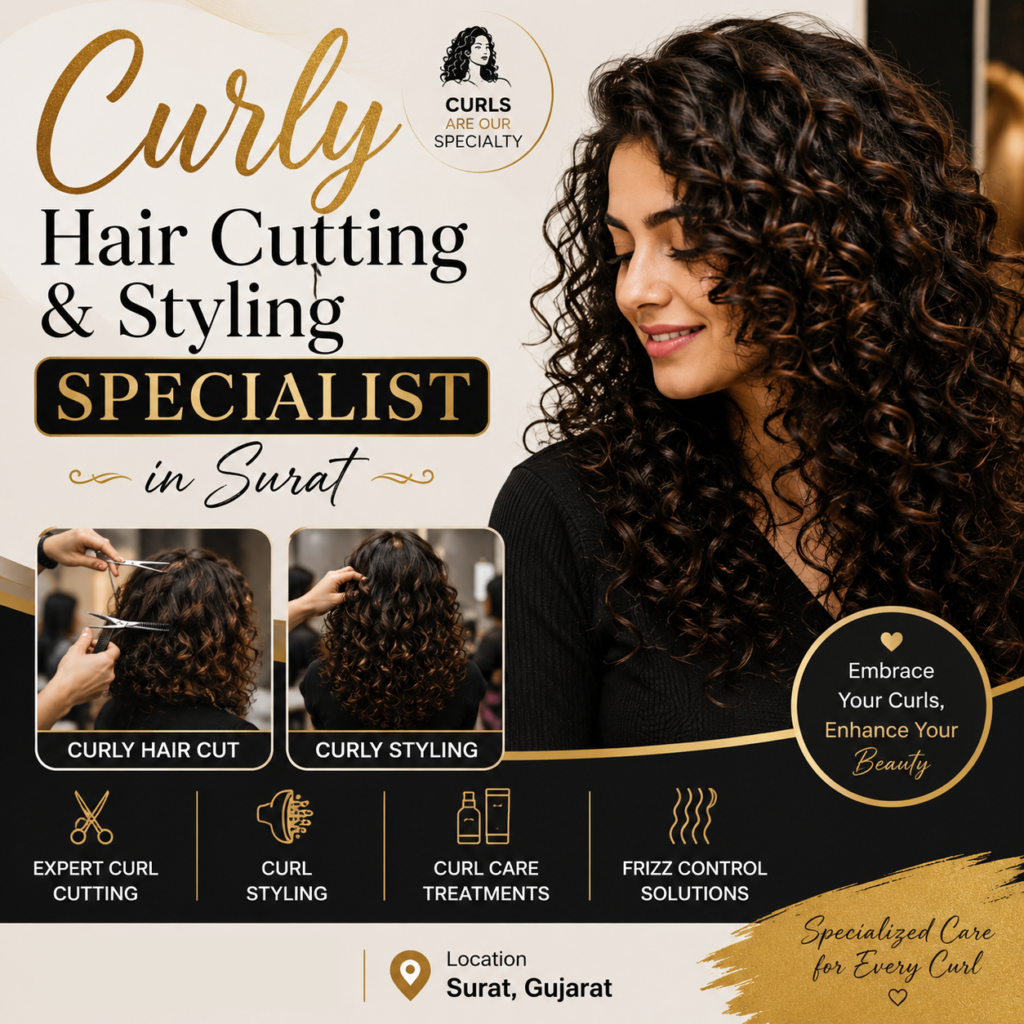
Curly Hair Cutting & Styling Specialist in Surat – Amee Patel
Finally, Surat Has a Curly Hair Specialist Who Gets Your Curls Meet Amee Patel – The Curly Hair Expert Changing the Way Surat Sees Its Spirals Picture this: You walk into a salon, sit down, and the stylist immediately reaches for a comb – dragging it straight through your dry, perfectly defined curls. You wince. You’ve been here before. An hour later, you walk out looking like a triangle. Sound familiar? If you have curly hair and live in Surat, this story probably hit a little too close to home. Here’s a stat that will make you feel less alone: over 60% of people with naturally curly or wavy hair report regularly receiving bad haircuts because their stylist lacked curl-specific training. In a city like Surat – where humidity is high, curl patterns are diverse, and the beauty industry is booming – the need for a dedicated curly hair specialist has never been more urgent. Enter Amee Patel – Surat’s leading curly hair cutting and styling specialist, and the woman who is quietly revolutionizing how curly-haired people in the city care for and celebrate their natural texture. This blog is your complete guide to understanding curly hair, why specialized care matters, and why Amee Patel is the name every curly girl (and guy) in Surat needs to know. What Does It Really Mean to Be a Curly Hair Specialist? Before we dive into Amee’s story, let’s clear up a common misconception: not every hairstylist is equipped to cut curly hair. A curly hair specialist is a stylist who has undergone specific training in: In contrast, a general stylist is typically trained on straight or chemically treated hair. They learn to cut hair wet, blow-dry it smooth, and style it flat – techniques that can cause shrinkage miscalculation, uneven layers, and frizz when applied to curly hair. This is why finding a true curly hair specialist in Surat like Amee Patel is not a luxury – it’s a necessity. Meet Amee Patel: Surat’s Trusted Curly Hair Specialist Amee Patel didn’t stumble into curly hair expertise by accident. Her journey is one of personal experience, professional dedication, and genuine passion. Her Story Growing up with naturally curly hair in Surat, Amee faced the same frustrations that countless curly-haired people know all too well – stylists who didn’t understand her texture, products that left her hair crunchy or frizzy, and a beauty industry that offered her one solution: straighten it. Determined to change that narrative – for herself and for others – Amee pursued specialized training in curl-specific cutting and styling techniques. She studied under certified curl educators, trained in methods like DevaCut and Ouidad, and immersed herself in the science of hair porosity, curl patterns, and scalp health. Today, Amee operates as Surat’s go-to curly hair specialist, serving clients with everything from loose beach waves (Type 2) to tight coils (Type 4), and everything in between. What Sets Amee Apart Understanding Your Curl Type: A Simple Guide One of the first things Amee does with every new client is identify their curl type. Here’s a quick breakdown of the curl classification system: The Curl Type Chart Type Description Example 2A Loose, barely-there waves Slight S-shape, very fine 2B Defined waves with some frizz Medium S-wave 2C Strong waves, frizz-prone Thick, wavy-curly mix 3A Loose, springy curls Large ringlets 3B Bouncy, defined curls Medium ringlets 3C Tight corkscrews Dense, springy spirals 4A Soft coils Tight S-pattern 4B Z-shaped coils Sharp zigzag pattern 4C Tightest coils Minimal definition, most shrinkage Most Indian people fall somewhere between Type 2C and Type 3C, though this varies widely. Amee’s expertise spans all curl types, making her one of the most versatile curly hair specialists in Surat. Current Trends in Curly Hair Styling (2024–2025) The curly hair world is evolving fast. Here’s what’s trending right now – and what Amee is bringing to her Surat clients: 1. The Curly Bob (Curl Bob or “CurlBob”) Short, bouncy, and full of personality – the curly bob is having a massive moment. When cut correctly on curly hair (dry, with curl shrinkage in mind), it creates a jaw-dropping shape that frames the face beautifully. 2. The Wash-and-Go Revival Minimalist hair routines are in. The wash-and-go – applying product to soaking wet hair and letting it air dry – is being embraced by curl types 3 and 4 for effortless definition without manipulation. 3. Protective Styling + Curl Health Focus Clients are increasingly prioritizing hair health over aesthetics. Deep conditioning, protein treatments, and scalp care are now as important as the haircut itself. 4. The “No Heat” Movement More curly-haired people in Surat are ditching their straighteners and embracing heatless styling — diffusing instead of blow-drying, using curl creams instead of flat irons. 5. Curl-Inclusive Salons There’s a growing demand for curl-dedicated salon spaces – places where curly-haired clients don’t feel like afterthoughts. Amee’s practice reflects this philosophy entirely. Amee’s Step-by-Step Curl Care Routine: Tips You Can Start Today Whether or not you’ve visited Amee yet, here’s the curl care guidance she shares with every client: Step 1: Ditch the Sulfate Shampoo Sulfates strip natural oils from curly hair, causing dryness and frizz. Switch to a sulfate-free cleanser or co-wash (conditioner-only washing) 1-2 times per week. Step 2: Deep Condition Weekly Curly hair is structurally drier than straight hair because the curl pattern prevents scalp oils from travelling down the hair shaft. A weekly deep conditioning mask (20-30 minutes) is non-negotiable. Step 3: Apply Products to Soaking Wet Hair This is the #1 mistake curly-haired people make. Products – leave-in conditioner, curl cream, gel – should be applied when hair is dripping wet, not damp. This locks in maximum moisture. Step 4: Use the “Squish to Condish” Technique While rinsing out conditioner in the shower, cup your hands and squish the water upward into your curls. This encourages curl clumping and definition. Step 5: Plop, Don’t Rub After showering, use a microfibre towel or cotton T-shirt to gently scrunch and “plop”